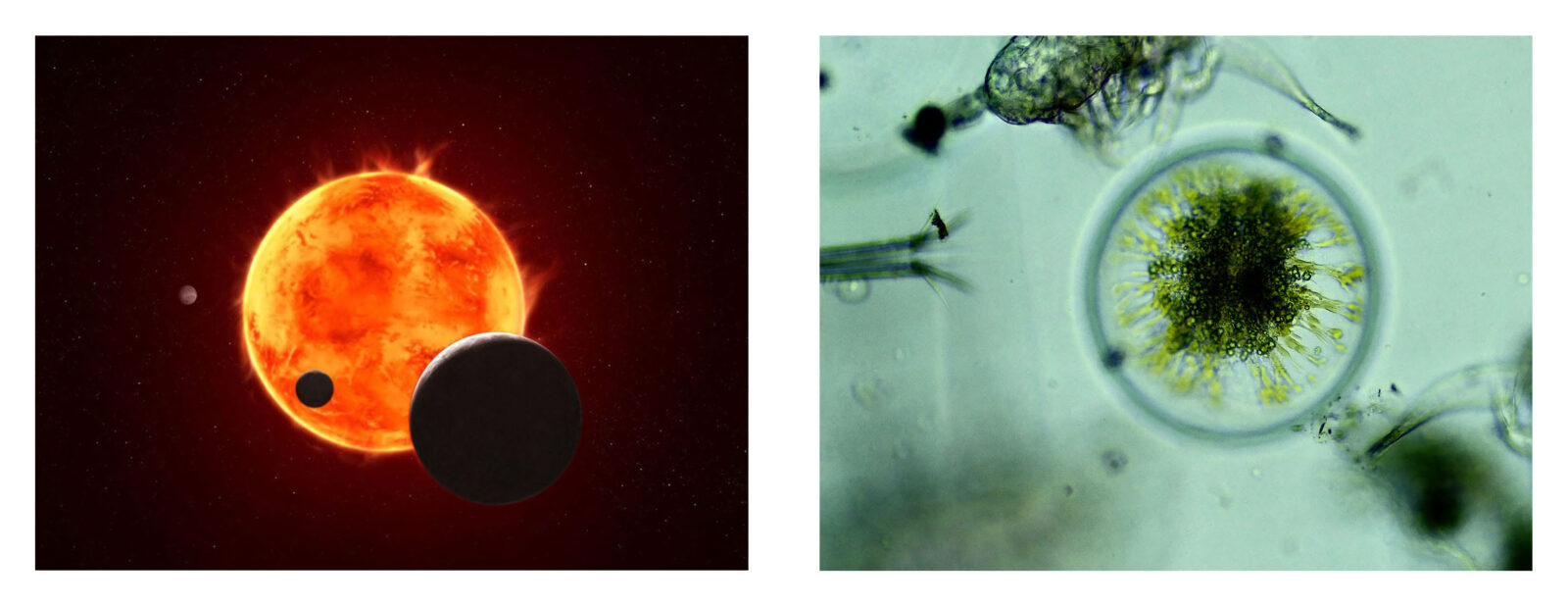
Under the microscope, I found Earthrise again.
Not on the horizon of the Moon, but inside a single phytoplankton cell drifting in the ocean.
The resemblance stopped me. It was unmistakable: a luminous sphere rising from darkness, like the image captured during Apollo 8 that changed how humanity saw our planet. But this time, the view did not come from space. It came from the smallest scales of life.
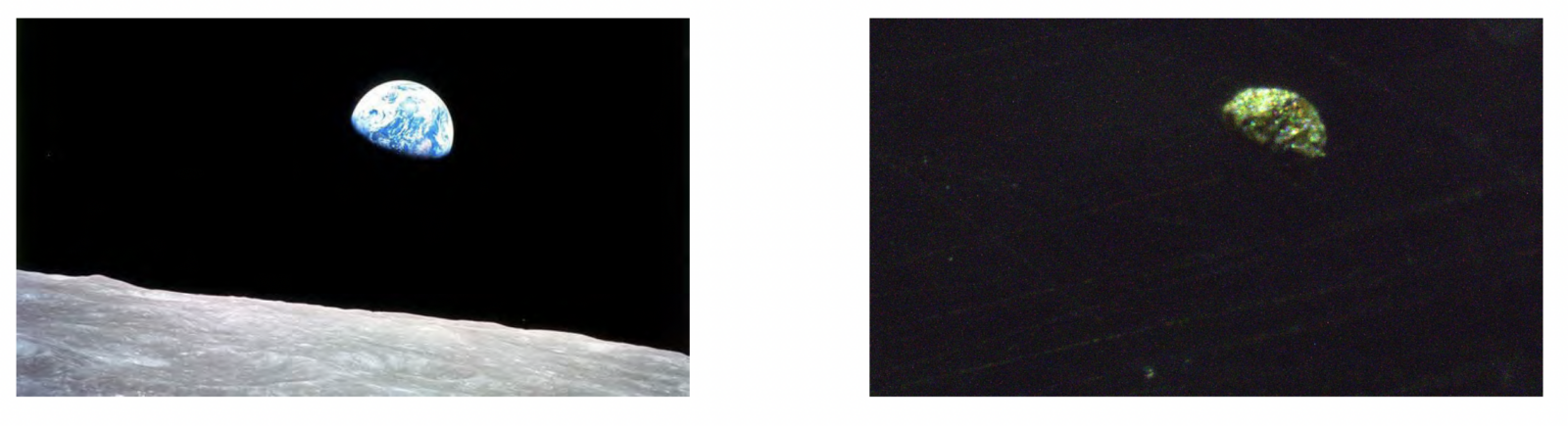
What struck me most was the inversion of perspective. Astronauts had to travel outward into the cosmos to see Earth as a fragile blue world suspended in blackness. Yet here, looking inward through a microscope, the same image appeared again — encoded within a microscopic organism that quietly helps sustain life on this planet.
Phytoplankton drift through the ocean’s upper layers, generating much of the oxygen we breathe and forming the foundation of marine ecosystems. They are nearly invisible to us, yet they shape the conditions that allow our world to exist.
Seeing Earthrise reflected in one of these tiny beings felt like discovering a hidden symmetry in nature: the macrocosm mirrored in the microcosm. It reminded me that the story of our planet is written across scales. The same patterns that appear in cosmic horizons can also emerge in drifting cells of light-filled life.
In that moment, it felt as though the planet was revealing itself twice — once from space, and once from within.
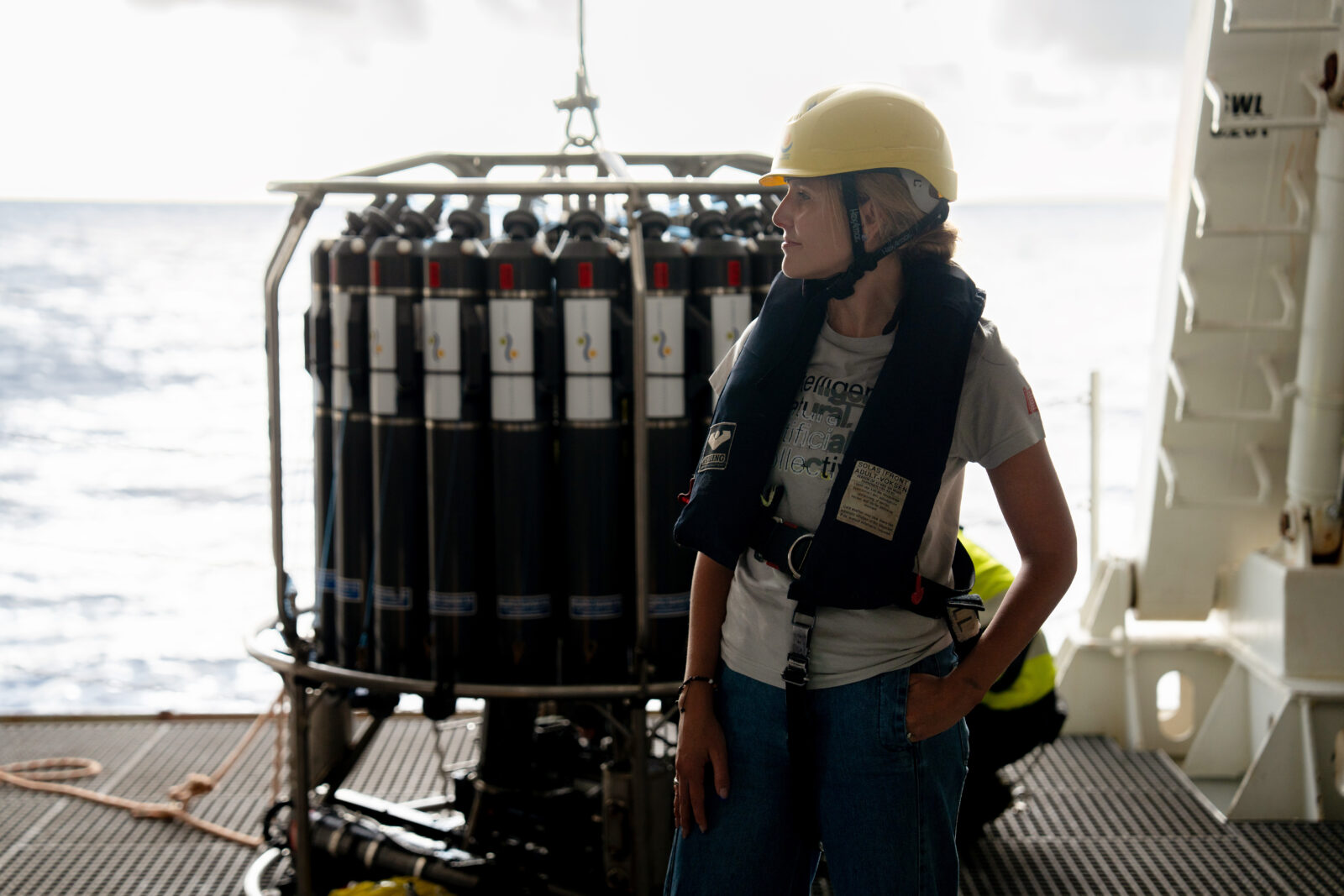
This experience became one of the guiding images of my five-week Artist-at-Sea voyage aboard Schmidt Ocean Institute’s R/V Falkor (too). Departing from Rio de Janeiro and crossing the expansive “blue desert” of the open ocean in international waters to the port of Salvador, Brazil, I created a new body of work exploring the deep connections between ocean and cosmos — two vast frontiers that continue to shape how we understand life on Earth.
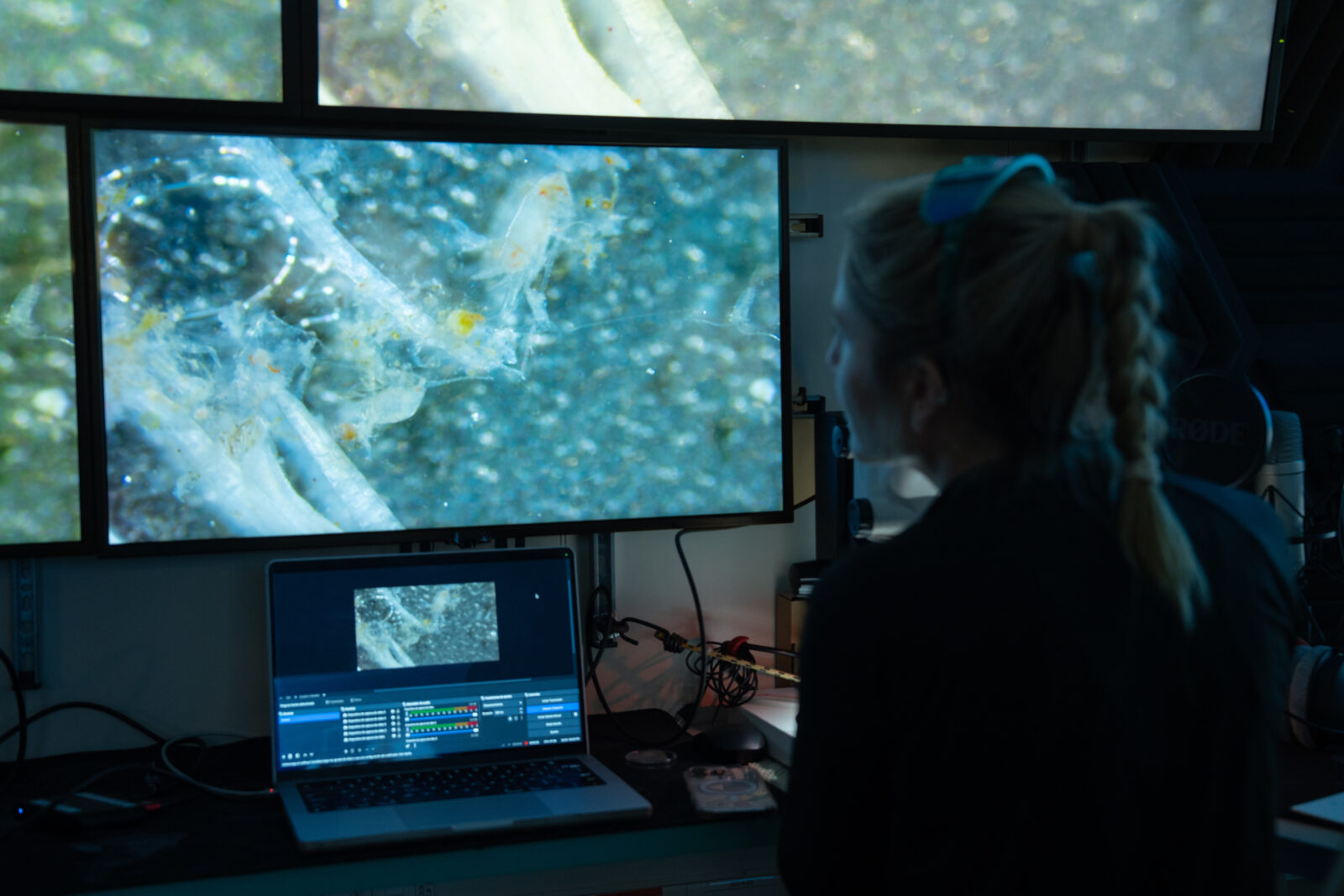
Nothing quite compares to making art at sea. The ship became a floating studio, research site, and exhibition space. Surrounded by scientists, engineers, marine technicians, and crew, I worked in response to the rhythms of expedition life: instrument deployments, microscope observations, ROV dives, data collection, long horizons, and the daily awareness of being held by an immense and living ocean.
There is a profound joy in venturing into places and realms that remain unseen — worlds that exist beyond the edges of our everyday perception. Much of my purpose as an artist lies in bringing these hidden dimensions into view: revealing what might otherwise go unnoticed, and celebrating the awe, mystery, and wonder of the world we inhabit.
At the microscopic scale, the ocean reveals an extraordinary richness. Each night, the planet’s largest migration unfolds beneath the surface, as vast communities of organisms rise from the deep to feed, then descend again by dawn. Diatoms form intricate, mandala-like geometries — entire universes held within a single structure — while zooplankton drift in forms so otherworldly they have inspired visions of extraterrestrial life in science fiction. There is so much to witness, to be astonished by, if only we are willing to look.
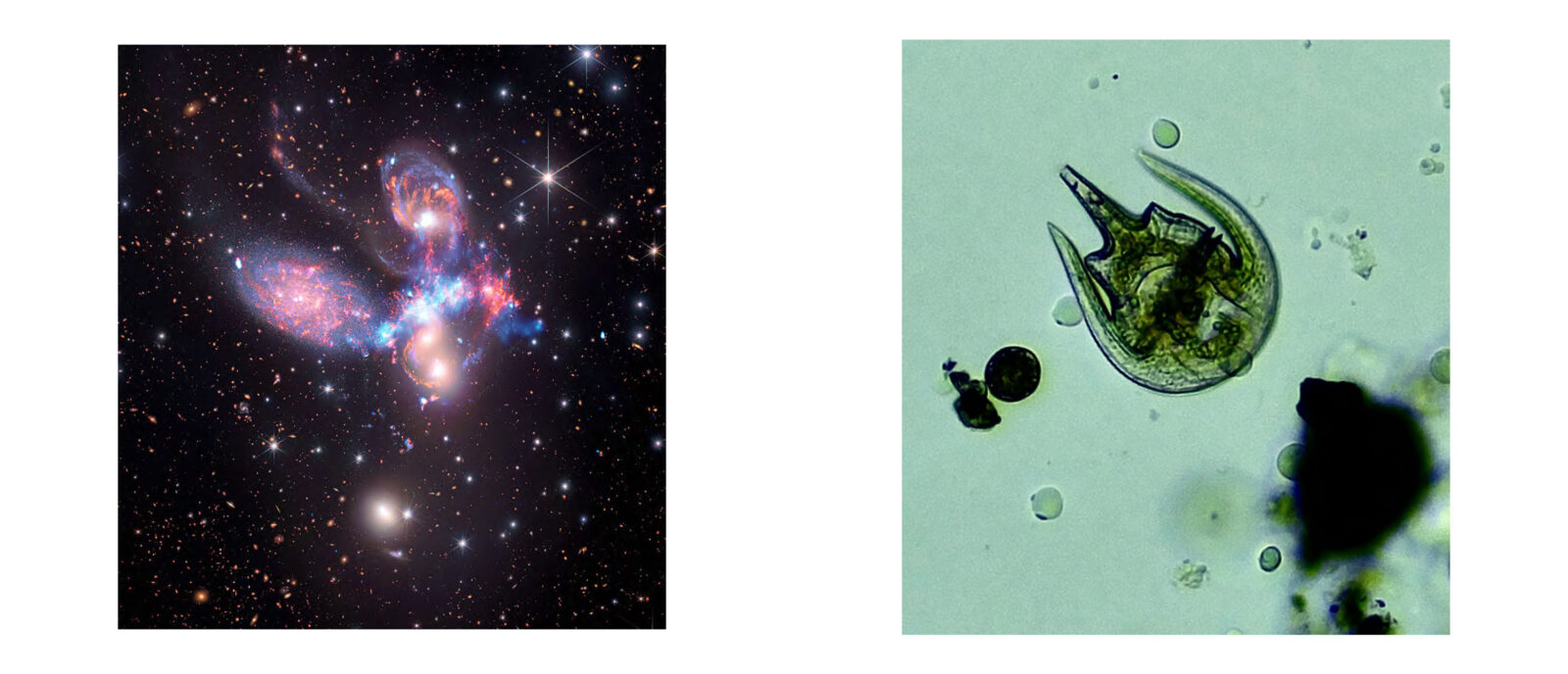
One series began with cyanotypes using imagery of plankton gathered during the voyage. I layered these oceanic forms with celestial imagery to build a kind of micro-macro universe — compositions where the drifting architectures of marine life meet the distant language of stars. Exposed to sunlight on the open deck, each piece was shaped by the same light that fuels photosynthesis in the ocean and allows us to perceive the cosmos.
The process felt like a collaboration with the environment itself. Salt air, shifting winds, humidity, the movement of the ship, and the intensity of the sun all imprinted themselves onto the work. What emerged were images that collapse distance and scale, suggesting that the patterns governing life in a drop of seawater echo those found across the universe.
These cyanotype tapestries became oceanic star maps: luminous blue fields where phytoplankton and zooplankton appeared like constellations. They are among the smallest beings in the sea, yet they help shape planetary systems of oxygen, carbon, and life. In their forms, I saw not only biology, but cosmology — evidence that the smallest structures on Earth can hold the feeling of galaxies.
Another project emerged through the microscope. I created field journals of diatoms and other microscopic organisms observed during the expedition, translating their intricate structures into drawings, notes, and visual studies. These organisms felt architectural, almost planetary — tiny worlds with glass-like forms, radial geometries, and patterns that echoed everything from coral structures to satellite imagery. Looking through the microscope became a kind of portal: a way of entering the cosmos through a single drop of seawater.
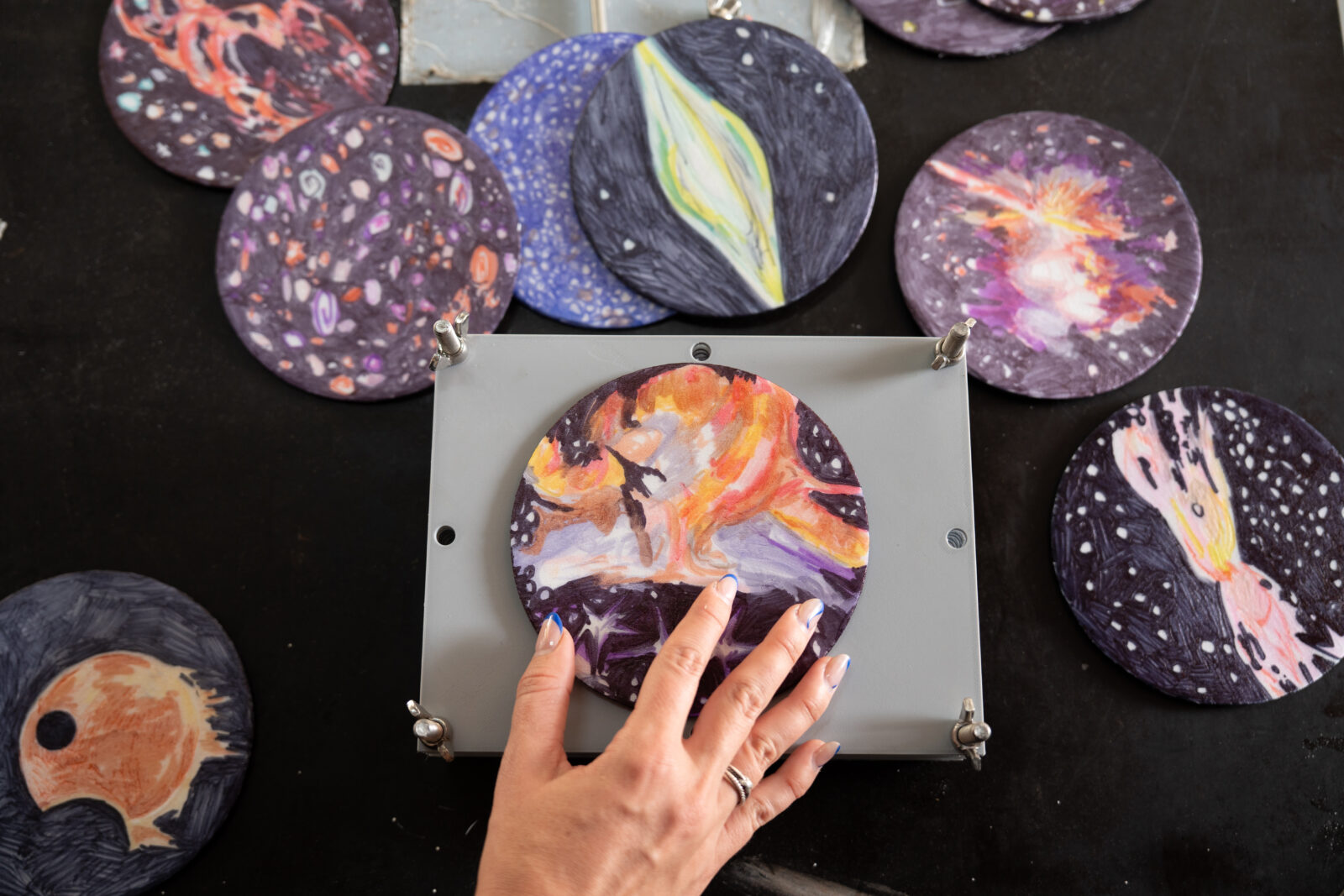
I also created a series of petri-dish-like cosmic drawings that were sent thousands of meters beneath the surface. These works were conceived as small offerings to the deep sea — circular drawings that referenced cells, planets, samples, and worlds within worlds. Sending them down to 5,000 meters below the surface transformed the drawings into witnesses. They entered an environment beyond human reach, carried briefly into the darkness by the tools of ocean exploration.
A related series grew from a long-standing oceanographic tradition: sending Styrofoam cups into the deep sea, where immense pressure compresses them into dense, miniature forms. Inspired by this simple and poetic experiment, I created Styrofoam replicas of objects I have sent to the Moon, as well as forms connected to works destined for an asteroid. These replicas were submerged at depths ranging from 1,000 to 5,000 meters, where the crushing pressures of the deep ocean transformed them.
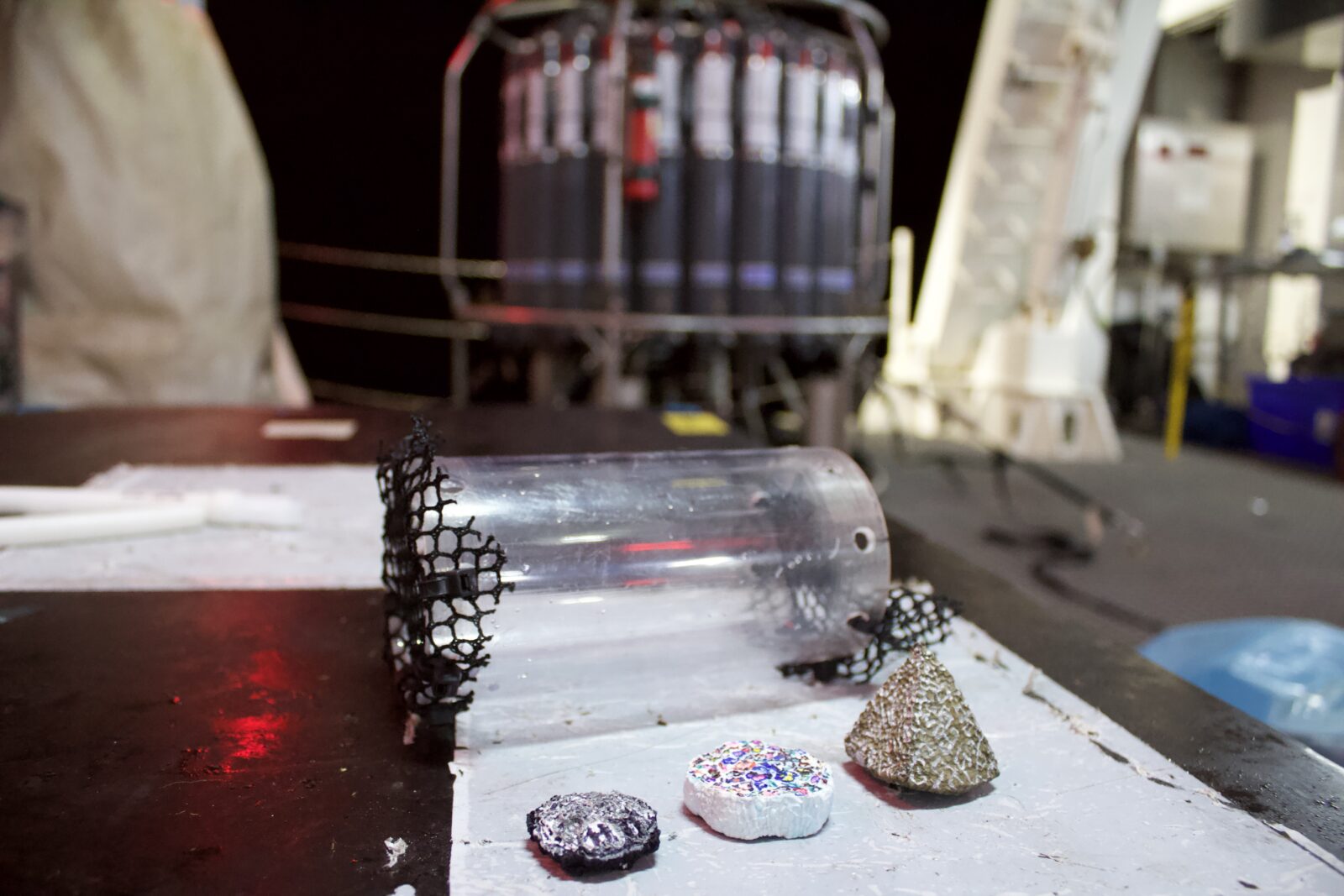
The resulting sea–space artifacts exist across extremes: from the surface of the Moon to the darkest depths of Earth’s oceans. They are not just replicas, but relics — compressed, altered, and returned as treasures from the deep. I think of them as material collaborations with two of the most inhospitable environments we know, where pressure, distance, time, and planetary forces shape the final work. The series also carries a more complicated reflection on the long life of plastics in the ocean — materials that can outlast us, bearing witness to both human imagination and human impact.
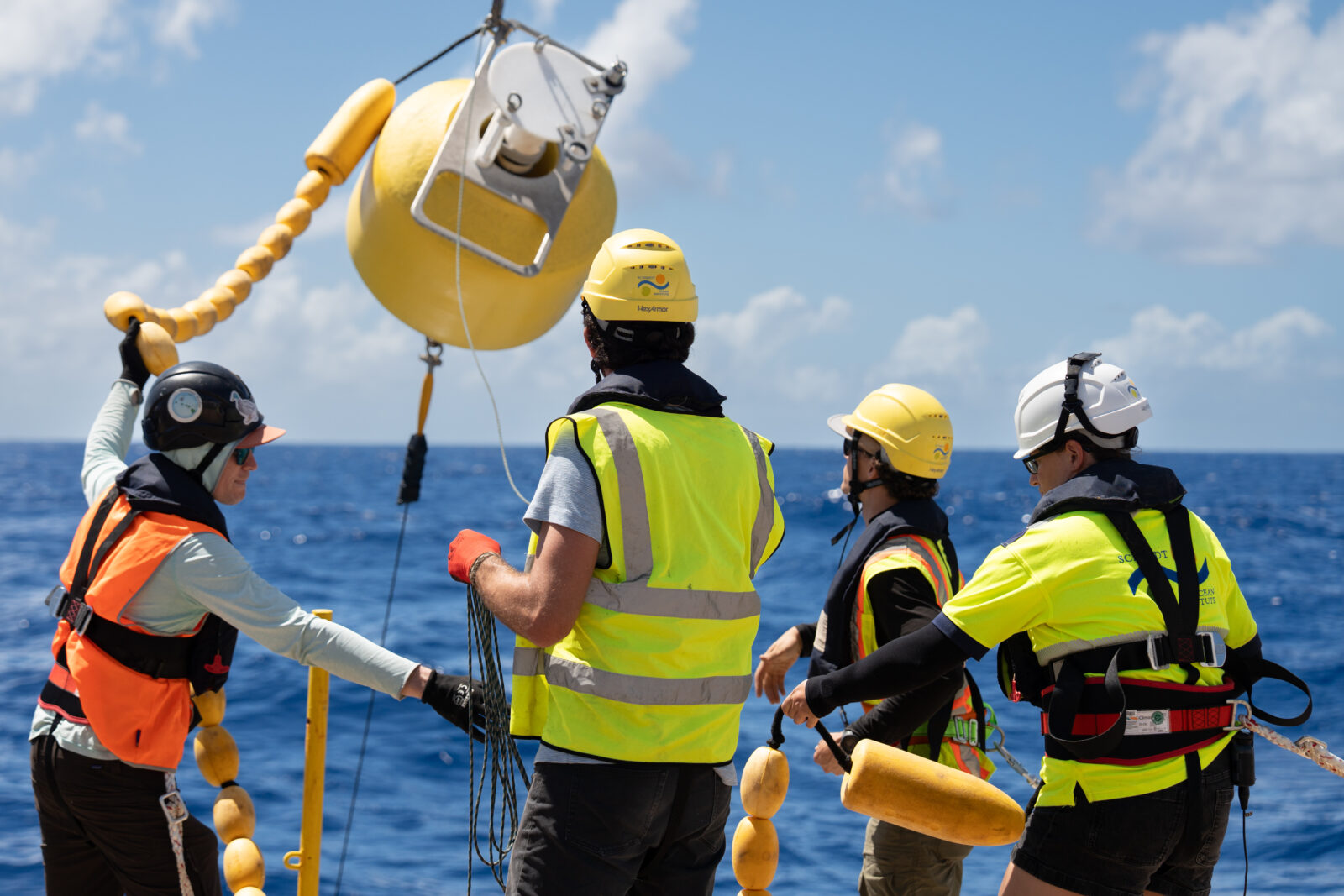
Video became another part of the work. I documented artworks being submerged into the deep sea, allowing them to move through water, pressure, darkness, and light. These gestures connected to a longer thread in my practice: making art for extreme environments, from the stratosphere to satellites to the Moon. But here, instead of looking outward into space, I was looking downward into the ocean — discovering another kind of vastness beneath us.
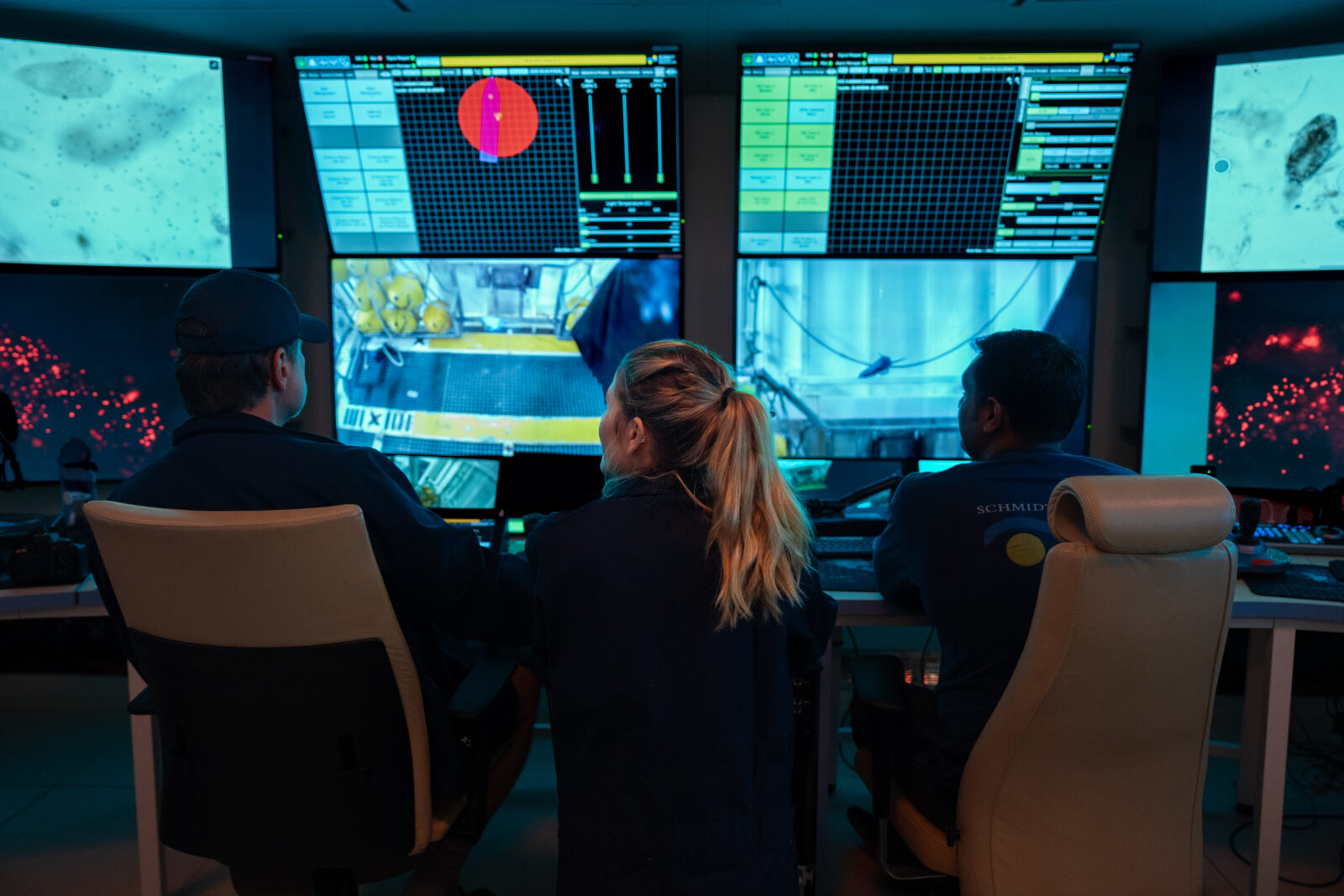
One of the most unexpected influences came from watching the ROV at work. Its robotic gestures — careful, precise, almost tender — reminded me of NASA’s Canadarm and other tools used in space exploration. The ROV became a kind of deep-sea astronaut: extending human reach into an environment we cannot physically inhabit. Its movements felt both technical and poetic, translating human curiosity through machine choreography.
In the middle of international waters, I transformed the ship’s hangar into a pop-up exhibition — my first art exhibition at sea. Cyanotypes, drawings, videos, field notes, sea–space artifacts, and research-inspired works were shared with the scientists, engineers, and crew who had been part of the voyage. There was something profound about showing the work not in a white-walled gallery, but in the working body of the ship itself — surrounded by equipment, ocean air, and the people whose labor made the expedition possible.
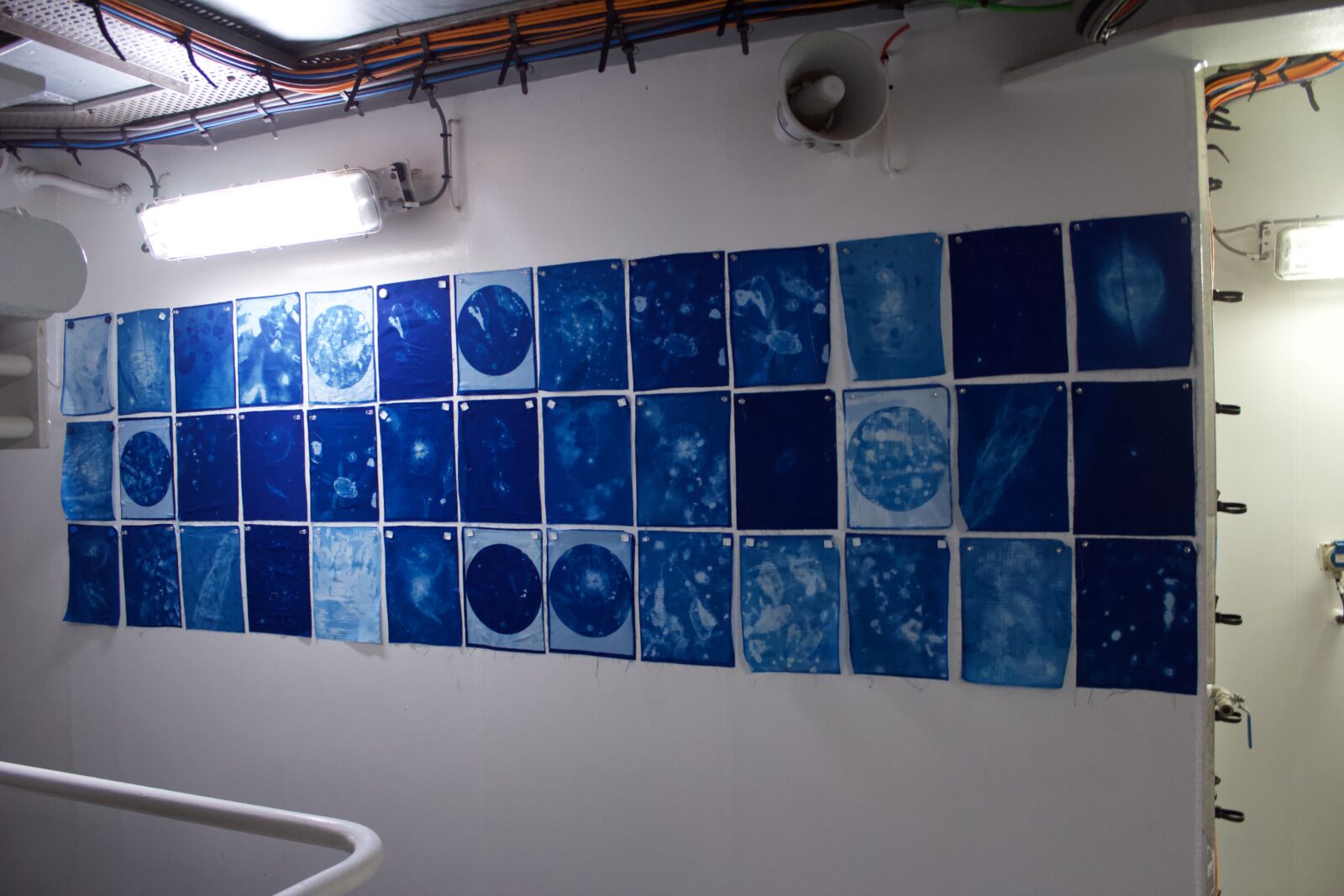
This experience changed how I think about exhibition-making. The works were not removed from the site of their creation. They were still in conversation with the water, the vessel, the research, and the daily life of the expedition. The exhibition became less about presenting finished objects and more about revealing a process of attention — a way of translating the unseen life of the ocean into forms that could be felt.
Throughout the voyage, I kept returning to the relationship between inner and outer worlds. The ocean and cosmos are often imagined as opposites — one below, one above — but they are mirrors of one another. Both hold origin stories. Both reveal how small we are. Both ask us to confront the limits of human perception. And both remind us that Earth itself is a spacecraft: alive, fragile, mysterious, and shared.
The body of work I began aboard R/V Falkor (too) will continue to evolve for future exhibitions linking sea and space. This series is an exploration of connection — an attempt to make visible the hidden systems that link ocean depths to outer space, and to remind us that we are part of both.
My time at sea reaffirmed something central to my practice: the more we explore extreme environments, the more clearly we can see the interconnected systems that make life possible. In the deep ocean, I found Earthrise in phytoplankton, galaxies in plankton fields, choreography in robotics, architecture in diatoms, relics shaped by pressure, and a universe in a single drop.
There is so much to witness, to be astonished by — and, in seeing, to care enough to protect it.